

Robinhood vs Fidelity explained, including which investors each platform fits best and why execution alone isn’t enough.
Sectors & Industries
January 24, 2026


Table of Contents
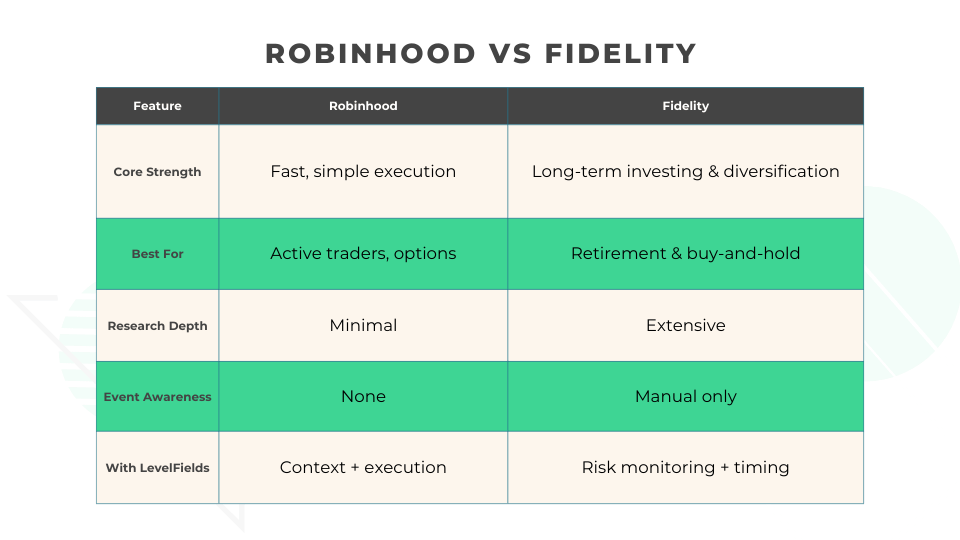
Robinhood and Fidelity are two of the most widely used investing platforms in the U.S., but they serve very different types of investors. Robinhood emphasizes simplicity, speed, and mobile-first trading, while Fidelity offers a full-service brokerage with deep research, retirement tools, and long-term portfolio support.
What often gets overlooked in this comparison is that neither platform is designed to tell you when something important has changed in the market. They are execution platforms not decision engines.
That’s where LevelFields AI fits in.
Below is a breakdown of Robinhood vs Fidelity, who each platform is best for, and how pairing either with LevelFields materially improves results.
Best for: Active retail traders, options traders, and mobile-first investors
Robinhood is designed to remove friction from trading. The platform offers commission-free stock, ETF, options, and crypto trading with a clean, intuitive mobile interface. There are no account minimums, and fractional shares make it easy to invest with small amounts of capital.
Robinhood works well for:
However, Robinhood provides very limited market context. It shows price movement, basic charts, and news headlines — but it does not explain why a stock is moving or whether a move has historically led to follow-through.
When paired with LevelFields, Robinhood becomes a clean execution layer rather than a guessing tool.
LevelFields identifies:
…and shows how those events historically impacted the stock, including:
Robinhood users can then execute trades quickly with context, instead of reacting emotionally to price movement or social sentiment.
Best for: Long-term investors, retirement savers, diversified portfolios
Fidelity is a full-service brokerage built for investors managing wealth over time. It offers stocks, ETFs, mutual funds, bonds, CDs, retirement accounts, and extensive research tools. Fidelity also provides strong customer support, portfolio analytics, and educational resources.
Fidelity works best for:
Despite its depth, Fidelity is still reactive by design. Research tools are effective, but they require investors to actively monitor news, filings, and disclosures.
LevelFields turns Fidelity into a proactive portfolio-monitoring system.
Instead of manually tracking news, LevelFields:
This allows Fidelity investors to:
Fidelity provides the tools to invest long term. LevelFields provides the early-warning system Fidelity does not.
Robinhood and Fidelity aren’t competitors in the way most comparisons suggest. They solve different problems:
What neither platform does well on its own is answering the most important question in investing:
Did something materially change and does history say it’s worth acting on?
That’s where LevelFields AI fits.
Many investors now use:
Execution platforms move money.
Decision intelligence determines outcomes.
Robinhood’s main downside is that it prioritizes simplicity over depth. While it offers commission-free trading and an easy-to-use interface, it provides limited research tools, fewer fixed-income options, and less advanced order control compared to full-service brokers. Execution quality and customer support have also been points of criticism for active or high-volume traders who need more transparency and control.
Fidelity’s primary drawback is complexity. Its platform offers extensive research, account types, and tools, but that depth can feel overwhelming for beginners. The interface is less streamlined than app-first brokers, and some advanced features are spread across multiple platforms, which can slow down newer investors.
“Better” depends on the investor’s needs. Fidelity is often considered better for long-term investors due to its research, retirement tools, and asset coverage. Active traders may prefer platforms with stronger charting and order execution. Investors focused on identifying market-moving events often pair brokers with external analysis tools rather than relying on a single platform.
Robinhood does not charge a standard $100 account fee. References to a $100 charge usually relate to optional services such as wire transfers, certain account transfer fees (ACATS), or margin-related costs, depending on circumstances. Fees vary by transaction type and are outlined in Robinhood’s official fee schedule.
Robinhood’s base trading fees are low or zero, but costs can appear higher through indirect fees. These include margin interest, spreads, optional subscriptions like Robinhood Gold, and transaction-specific fees such as regulatory charges or transfers. For frequent traders or margin users, these costs can add up.
Robinhood accounts are primarily designed for U.S. residents. While users may temporarily access their accounts while abroad, maintaining or opening a Robinhood account generally requires U.S. residency and a U.S. address. Long-term use outside the U.S. may be restricted depending on location and account activity.
Join LevelFields now to be the first to know about events that affect stock prices and uncover unique investment opportunities. Choose from events, view price reactions, and set event alerts with our AI-powered platform. Don't miss out on daily opportunities from 6,300 companies monitored 24/7. Act on facts, not opinions, and let LevelFields help you become a better investor.

AI scans for events proven to impact stock prices, so you don't have to.
LEARN MORE