

From EMCOR to Vertiv to Cameco, the AI boom is driving massive demand for construction, cooling, metals, power, and nuclear.
Sectors & Industries
December 1, 2025


Table of Contents
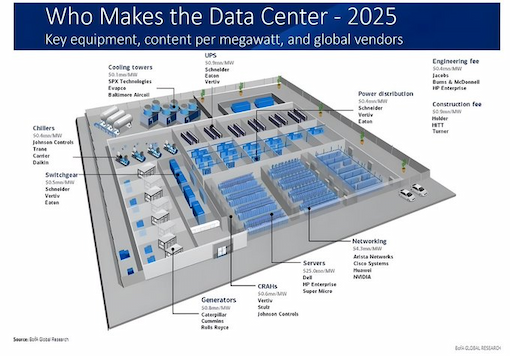
Starting with the basics: AI requires computing power. Compute needs data centers. And data centers are not just “buildings full of servers” — they are industrial complexes made of hundreds of physical components that must all work perfectly, all the time.
Data Centers: The Starting Point of the Bottleneck Chain
Companies like EME (EMCOR) build and wire these facilities — from switchgear rooms and cooling tunnels to backup generators and high-voltage power feeds. Without EPC contractors like EME, new AI campuses simply don’t get built.
AI demand → more data centers → more EMCOR-type construction capacity
Racks & Servers: Where AI Actually Lives
Inside each data center are tens of thousands of server racks from companies like SMCI (Super Micro) and Dell. These racks integrate GPUs, networking gear, and custom power systems. The more AI model training accelerates, the faster this layer expands.
Racks get denser → more heat → more power → more stress on cooling
Chips & Materials: The Metals Layer
Every server rack is filled with chips made of copper, gallium, germanium, high-grade silicon, and transformer steel.
This is where the strategic materials trade comes in:
Cooling
AI servers run extremely hot. Cooling systems from Vertiv (VRT), Trane (TT), Johnson Controls (JCI), and Stulz keep temperatures from reaching silicon-meltdown levels.
The CME outage proved the point:
When cooling fails, trading stops. When cooling fails at an AI campus, the AI stops.
Water: The Hidden AI Input
Cooling takes enormous amounts of fresh water.
AI queries indirectly consume 1–3 bottles of water per query once you include:
This is why water utilities and water-equipment companies are already raising long-term spending:
AI → more cooling → more water → more water infrastructure capex
This bottleneck is growing faster than most investors realize.

Electricity
Electricity prices are up ~35% since 2020, and Goldman now says 9 of 13 U.S. power regions are already “critically tight.”
AI data centers run 24/7, drawing more power than steel mills.
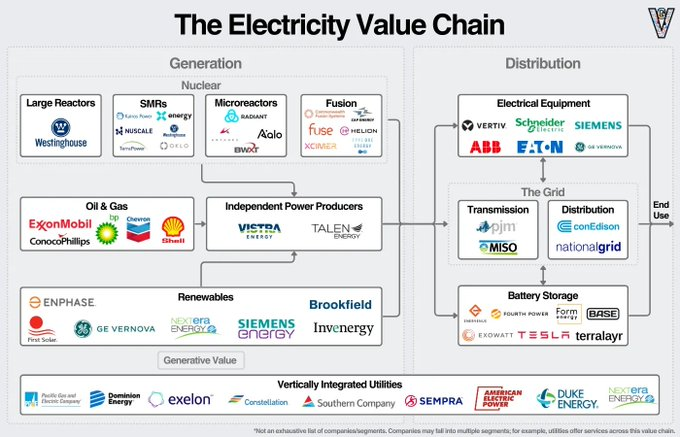
The utilities who can supply this power — and pass the cost into their rate base — are already preparing for an AI-driven boom:
The more AI grows, the more power grids stretch to their limits.
Nuclear
Once you add up water, cooling, and grid strain, the world runs into a simple wall:
There is no way to power AI with existing energy sources.
Gas can’t keep up. Renewables can’t run 24/7.
That’s why nuclear has gone from “long-term idea” to near-term buildout.
Deloitte projects that U.S. data centers could consume: 176 gigawatts by 2035 — more than 5× today’s demand. At that scale, you need round-the-clock, high-density power. Nuclear is one of the few technologies that can realistically deliver that.
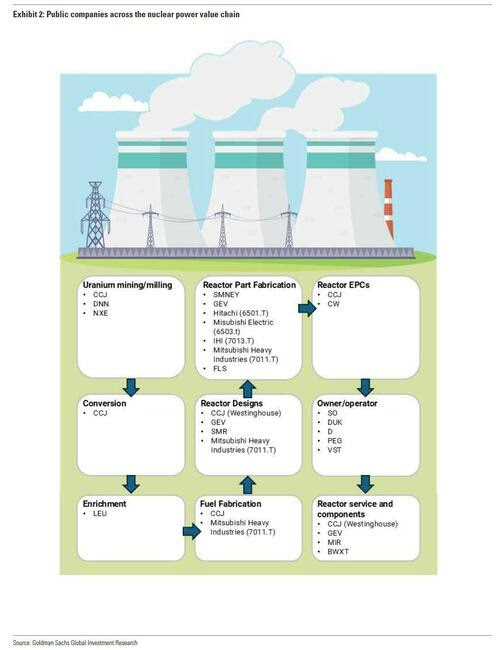
Here’s the full nuclear trade, broken into its parts:
Fuel Supply — Uranium Producers
These are the companies that benefit first as reactors scale:
Enrichment — The Most Critical Chokepoint
44% of global enrichment historically came from Russia.
The U.S. is rebuilding this capacity.
Only one U.S. company is already producing advanced reactor fuel:
Reactor Builders — The Companies Making the Hardware
These firms build the SMRs (small modular reactors), next-gen cores, and naval reactors:
Nuclear Operators — The Utilities That Will Sell Power to AI Giants
These companies have nuclear fleets already operating and selling baseload power at premium pricing:
Construction & EPC — The Builders of the New Nuclear Fleet
When the NRC (U.S. Nuclear Regulatory Commission) approvals accelerate, these are the firms that build:
Join LevelFields now to be the first to know about events that affect stock prices and uncover unique investment opportunities. Choose from events, view price reactions, and set event alerts with our AI-powered platform. Don't miss out on daily opportunities from 6,300 companies monitored 24/7. Act on facts, not opinions, and let LevelFields help you become a better investor.

AI scans for events proven to impact stock prices, so you don't have to.
LEARN MORE