

Cooling failure at CME’s data center revealed how market stability now depends on electricity, heat management, and AI-era infrastructure.
Sectors & Industries
December 1, 2025


Table of Contents
Futures for the S&P 500, Treasuries, oil, metals, and farm goods suddenly stopped updating Thursday. Traders around the world stared at screens with frozen prices, unsure if something was breaking underneath the surface.
The cause wasn’t a cyberattack or a financial crisis.
It was a cooling failure.
A major data center in Aurora, Illinois — the facility that runs the electronic engines for CME Group, the world’s largest derivatives exchange — lost the ability to keep its servers cold. As temperatures climbed past safe limits, the machines automatically shut themselves off to avoid permanent damage. When that happened, the majority of U.S. futures trading — the core of global price discovery — went dark.
One overheated room took out the central nervous system of global price discovery.
U.S. data centers already consumed 183 terawatt-hours of electricity last year — more than the entire country of Pakistan. And the curve is steepening fast.
By 2029, data centers are expected to account for around 10% of total U.S. electricity demand, and by 2030, total consumption is projected to more than double from current levels. Every watt becomes heat. Every server needs cooling. Most of these buildings were designed for 2015-level computing, not the far heavier AI loads of 2025.
And it’s already showing up on the ground.
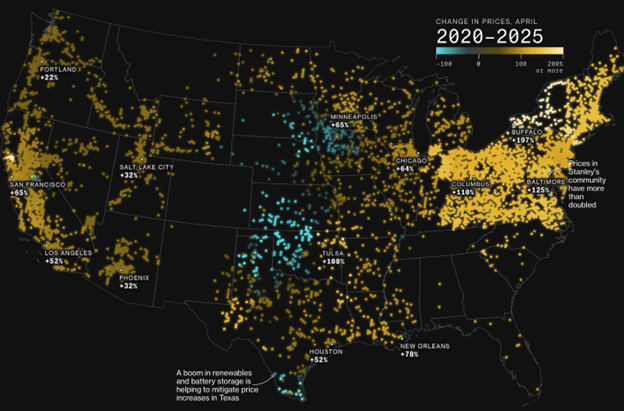
The map below highlights where electricity prices and congestion are rising the fastest — and more than 70% of the nodes with price spikes are located within 50 miles of major data-center activity. This isn’t evenly distributed strain. It’s clustered exactly where AI campuses are multiplying.
This is exactly why we’ve been highlighting Vertiv (VRT) for months. Vertiv builds the cooling and power-management systems that keep data-center racks from cooking themselves. Modern AI clusters run so hot that cooling loops often need to hold temperatures near sub-zero at the cooling point — a process that requires huge amounts of electricity and fresh water. Every AI model, every trading engine, every cloud service depends on this. When cooling fails, everything stacked above it is at risk.
VRT jumped 12% this week, reflecting how essential these behind-the-scenes companies have become. Vertiv was also a past Level 2 trade, and we’ve been writing about its importance to the AI build-out long before this outage.
The CME incident made something very clear:
the limits on modern markets aren’t software problems — they’re physical problems: heat, electricity, water, and cooling.
Join LevelFields now to be the first to know about events that affect stock prices and uncover unique investment opportunities. Choose from events, view price reactions, and set event alerts with our AI-powered platform. Don't miss out on daily opportunities from 6,300 companies monitored 24/7. Act on facts, not opinions, and let LevelFields help you become a better investor.

AI scans for events proven to impact stock prices, so you don't have to.
LEARN MORE