


.png)
L2 Weekly Stock Market News Analysis
December 7th, 2025

TLDR:
US stocks ended the week slightly higher as cooling inflation, softer hiring, and renewed liquidity hopes pushed rate-cut expectations to their strongest levels yet. The S&P 500 rose 0.85%, the Nasdaq gained 1.75%, and the Dow added 0.79%, with all three indexes grinding closer to all-time highs. A surprise 32,000 drop in private-sector payrolls reinforced bets on a December Fed cut — now priced at roughly 87% odds — while a light PCE reading and firmer Michigan sentiment added confidence that inflation is easing without a sharp downturn.
Institutional investors stepped in aggressively, delivering one of their biggest equity-buying weeks since 2008, according to BofA, as money flowed back into single-stock positions. Tech leadership broadened: Alphabet, Meta, and Broadcom helped lift the Nasdaq, while Salesforce jumped on strong results. Bitcoin also extended its rebound as major banks expanded stablecoin and custody pilots with Coinbase, signaling improving sentiment across digital assets.
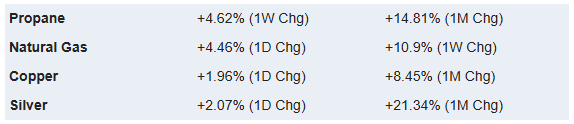
At the individual stock level, robotics and AI-infrastructure names surged after reports of a potential federal executive order supporting the sector. iRobot soared 74% on reports of support for the U.S. domestic robotics industry by the Trump administration. Retail was mixed: American Eagle gained 15% on strong earnings and raised guidance, while Macy’s fell on a softer outlook. Dollar Tree climbed after lifting full-year EPS guidance. In commodities, copper futures hit a record high as tariff-driven supply concerns fueled new demand for metals-linked equities.
Payroll Surprise Boosts Rate-Cut Odds — and Reshapes Market Expectations
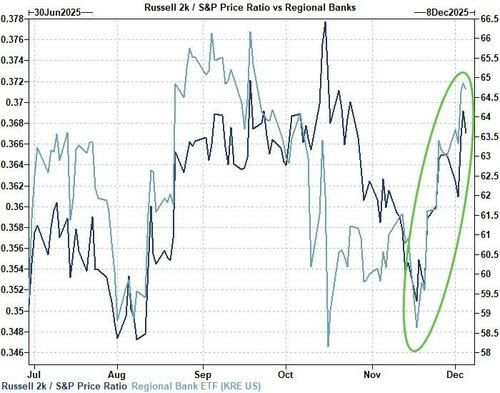
A surprise 32,000 drop in private-sector payrolls — the largest decline in more than two years — pushed traders to almost fully price in a Fed rate cut this week. The ADP report often swings more than the official jobs numbers, but with the shutdown delaying the government’s data, this is the only hiring snapshot the Fed will see before voting, giving it unusual importance. Markets reacted quickly: stocks moved back toward record highs, and rate-sensitive areas like small caps, regional banks, utilities, and credit-exposed consumer names all rallied as cut odds jumped from ~40% to nearly 95%.
But the backdrop is far more complicated. Borrowing costs for homes, cars, and credit cards remain high, which is slowing big purchases and weighing on rate-sensitive parts of the economy. Tariffs have pushed up import prices from China, Japan, and the EU, raising costs for small businesses and causing many to freeze hiring — the “no-hire, no-fire” pattern showing up in surveys. Manufacturing has also been shrinking for nine straight months as companies delay factory projects and equipment orders until tariff rules become clearer. In this environment, a rate cut may lift markets much faster than the real economy, because stocks react immediately while households and businesses won’t feel meaningful relief until borrowing costs and tariff pressures ease.
That’s why the Fed’s tone matters. Inflation cooled to 3% and hiring has softened, but the overall picture is still mixed. Tariffs continue to raise input costs, businesses are cautious about new investment, and consumer borrowing remains expensive. Given that, the Fed may cut rates while still signaling caution — a “hawkish cut” — offering some support without committing to a rapid series of future cuts.
Markets, however, are positioned for something much friendlier. Small caps jumped more than 7% as traders pushed cut odds from about 40% to nearly 95%, and rate-sensitive groups like regional banks and utilities rallied alongside them. We’ve seen what happens when the Fed disappoints: in a similar setup last year, the Russell 2000 fell 3% the week after a hawkish cut even as the S&P barely moved. The stronger the run-up, the more exposed these stocks are if Powell hints that future cuts will be slow or uncertain.
What a Hawkish Cut Means for Stocks — and Why This Week’s Tech Earnings Matter
If the Fed cuts rates but signals that future moves will be limited, the biggest hit would fall on companies that depend on cheaper credit. Smaller firms and regional banks — UPST, RKT, SOFI, AFRM, ALLY, RF, CMA — already face higher funding costs and would feel the most pressure if the Fed hints that relief will come slowly. A cautious tone also hurts unprofitable tech names, which rely heavily on low borrowing costs and have been trying to stage a rebound — including higher-beta AI and quantum names like RGTI, QBTS, IOT, and other cash-burning software and infrastructure plays — and a hawkish cut would make that much harder.
That’s why this week’s tech earnings carry extra weight. Oracle, Adobe, and Broadcom all report in the coming days, and investors want confirmation that AI- and cloud-related spending is still strong enough to support the broader market. Solid guidance could help steady sentiment even if rate-sensitive stocks pull back. But if tech disappoints at the same time the Fed sounds cautious, the rally loses both its earnings anchor and its momentum.
In short: a hawkish cut raises the stakes for this week’s tech reports. Strong results can keep the rally intact; weak results could quickly take the air out of it, especially for the most vulnerable parts of the market.
Google Surges Ahead as the Market Rethinks the AI Leaderboard
The stakes around tech earnings this week are rising just as the market undergoes a major sentiment shift inside the AI trade. For most of the year, OpenAI acted as the gravitational center of the boom — the company that pulled Oracle, AMD, CoreWeave, Microsoft, Nvidia, and dozens of suppliers higher on sheer momentum. But over the past few months, confidence has cracked. Investors are now openly questioning whether OpenAI can scale fast enough to fund its massive compute commitments, especially after GPT-5 drew mixed reviews and competitors closed the gap more quickly than expected.
That uncertainty has started to weigh directly on the stocks tied most closely to OpenAI’s growth path. When a company’s entire ecosystem is priced for moonshot adoption, even small doubts about model quality or revenue timing can trigger outsized drawdowns. The market is now treating that risk seriously — and reallocating accordingly.
The Capital Rotation Toward Google Is Real — and Accelerating
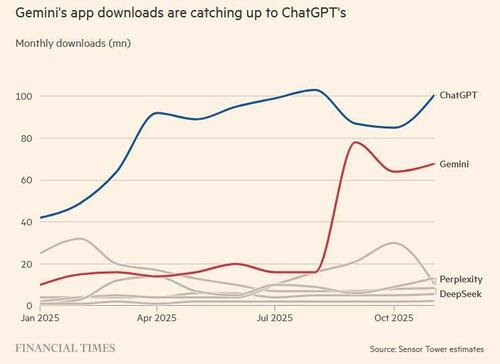
Google, meanwhile, is benefiting from the opposite narrative: consistency, cash, and clear execution. Its newest Gemini release arrived to rave reviews, but the real story is everything behind it — a fortress balance sheet, global distribution, and multiple profitable businesses (Cloud, YouTube, Search, hardware, Waymo) that can fund the AI race at scale. Investors increasingly see Google as the player with the most complete stack: data, compute, chips, model performance, and distribution.
That confidence shows up in performance. A basket of OpenAI-linked stocks is up a strong 74% this year — but that’s dwarfed by the 146% surge in companies tied to Google’s buildout, from Broadcom’s custom TPU chips to Lumentum and Celestica’s data-center hardware. Those firms are seeing rising orders, expanding backlogs, and supply-demand tightness that OpenAI’s partners no longer consistently enjoy.
Key Stocks Linked to OpenAI’s Ecosystem
- Oracle (ORCL) — primary cloud partner
- AMD (AMD) — major GPU supplier
- CoreWeave (private) — compute partner; benefits via NVIDIA hardware
- Microsoft (MSFT) — strategic investor and cloud host
- Nvidia (NVDA) — indirect beneficiary through model-training demand
- SoftBank (SFTBY) — 11% stake in OpenAI
Key Stocks Linked to Google’s AI Ecosystem
- Alphabet (GOOGL) — Gemini, TPU roadmap, Google Cloud
- Broadcom (AVGO) — designs and manufactures Google’s custom TPU chips
- Lumentum (LITE) — optical components for Google data centers
- Celestica (CLS) — hardware builder for Google’s AI infrastructure
- TTM Technologies (TTMI) — high-performance circuit boards for AI hardware
- Marvell (MRVL) — networking and accelerators supporting cloud expansion
If the Fed delivers a hawkish rate cut this week — one that pressures unprofitable tech names and weak balance sheets — this divergence may widen. In a more selective market, capital gravitates toward the companies that can fund AI with internal cash flow, not leverage or aggressive forward promises. Right now, that points more toward Alphabet’s ecosystem than OpenAI’s, at least in the near term.
Last's Weeks Sector Winners & Losers
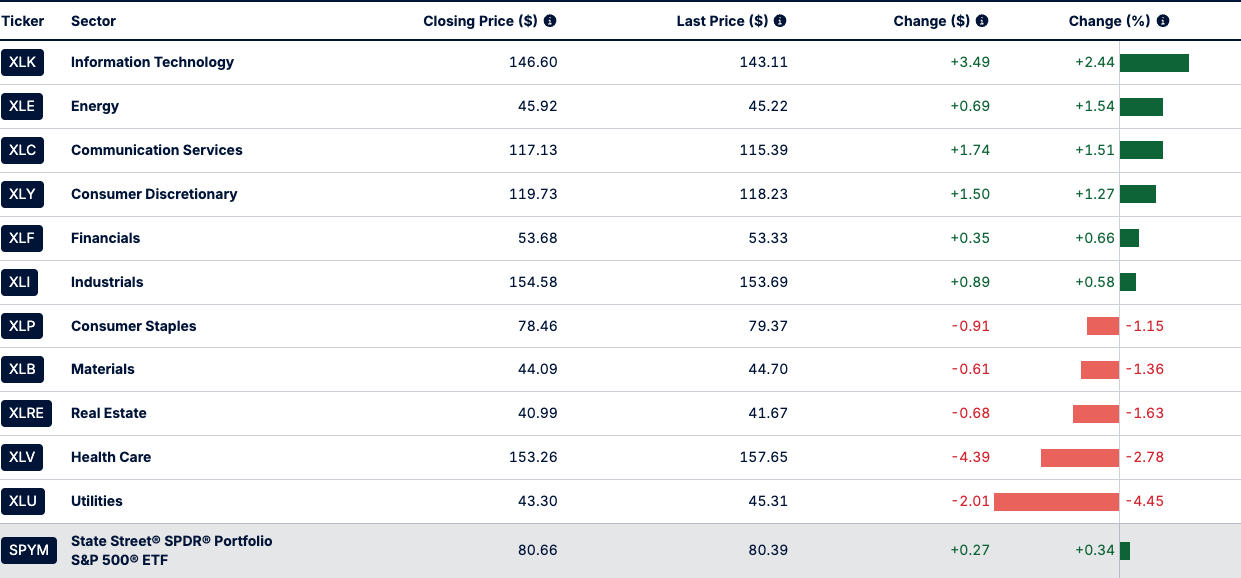
Sector performance leaned positive, with growth-heavy groups leading the market. Technology (XLK) rose +2.44%, followed by Energy (XLE) +1.54% and Communication Services (XLC) +1.51%, reflecting renewed appetite for cyclicals and rate-sensitive names ahead of this week’s Fed decision. Consumer Discretionary (XLY) and Financials (XLF) also posted steady gains.
More defensive and income-oriented sectors struggled. Consumer Staples (XLP), Materials (XLB), and Real Estate (XLRE) all finished lower, while Health Care (XLV) and Utilities (XLU) saw the sharpest declines at -2.78% and -4.45%, respectively — a notable reversal given how strongly they traded during recent volatility.
Upcoming Events This Week
U.S. markets enter a high-stakes week dominated by the Federal Reserve’s final policy meeting of the year. Traders widely expect a 25 bp rate cut, with markets pricing in two to three more cuts in 2026 as hiring cools and inflation drifts lower. The Fed will also release updated economic projections — but importantly, because of the recent government shutdown, policymakers are working with stale data, having no official readings beyond September.
A backlog of delayed U.S. data will finally hit markets, including JOLTS job openings, the trade balance, wholesale inventories, the Q3 Employment Cost Index, the federal budget, and weekly jobless claims. These releases will shape how investors interpret the Fed’s tone — especially whether Powell signals confidence or caution about further easing.
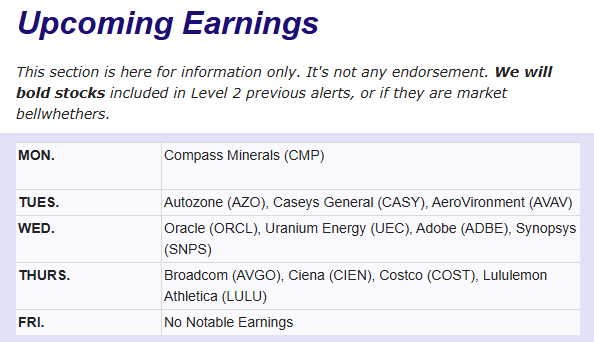
Corporate earnings also return to the spotlight, with Broadcom and Oracle reporting results, offering a key read on AI infrastructure spending and cloud demand.
.png)
Company News
LevelFields AI Stock Alerts Last Week
FTEL Jumps 41% on $3M Buyback Announcement
Fitell Corporation (FTEL) spiked 41% in a single session after announcing a $3 million share repurchase program—a sizable commitment relative to its float and a clear signal of management confidence. The 24-month buyback will be funded through existing cash and operating cash flow, with leadership explicitly stating that FTEL’s current valuation doesn’t reflect its progress in e-commerce, AI-driven robotics, and digital operations. The move tightened supply, boosted sentiment, and positioned FTEL as a high-momentum name heading into year-end.
WBD +6.2% on Exclusive Netflix Deal Talks — Alerted via Billion-Dollar Contract Scenario
Warner Bros. Discovery (WBD) jumped 6.2% after news that the studio has entered exclusive negotiations to sell its film and TV studios — including HBO, HBO Max, and its full content library — to Netflix. The deal is massive in scope: Netflix is reportedly offering a $5 billion breakup fee, signaling how aggressively it wants to close. If completed, Netflix would instantly become owner of HBO, DC Studios, Harry Potter, Friends, and Warner’s entire Burbank production complex.
This headline was delivered to LevelFields users through the Billion-Dollar Contract scenario.
The transaction would represent one of the biggest entertainment mergers in decades, joining the world’s largest paid streaming platform with one of Hollywood’s oldest studios. It also shifts the competitive landscape: Paramount and Comcast have been outbid, Paramount has already called the process “tainted,” and regulators in the US and Europe are expected to scrutinize the combined entity’s market power.
Warner Bros. formally put itself up for sale in October, and a deal could be announced within days if talks don’t fall apart. Netflix shares dipped slightly on the news, while WBD rallied on expectations of a premium valuation and a clearer long-term path after years of balance-sheet strain.

Introducing the LevelFields Portfolio Tracker
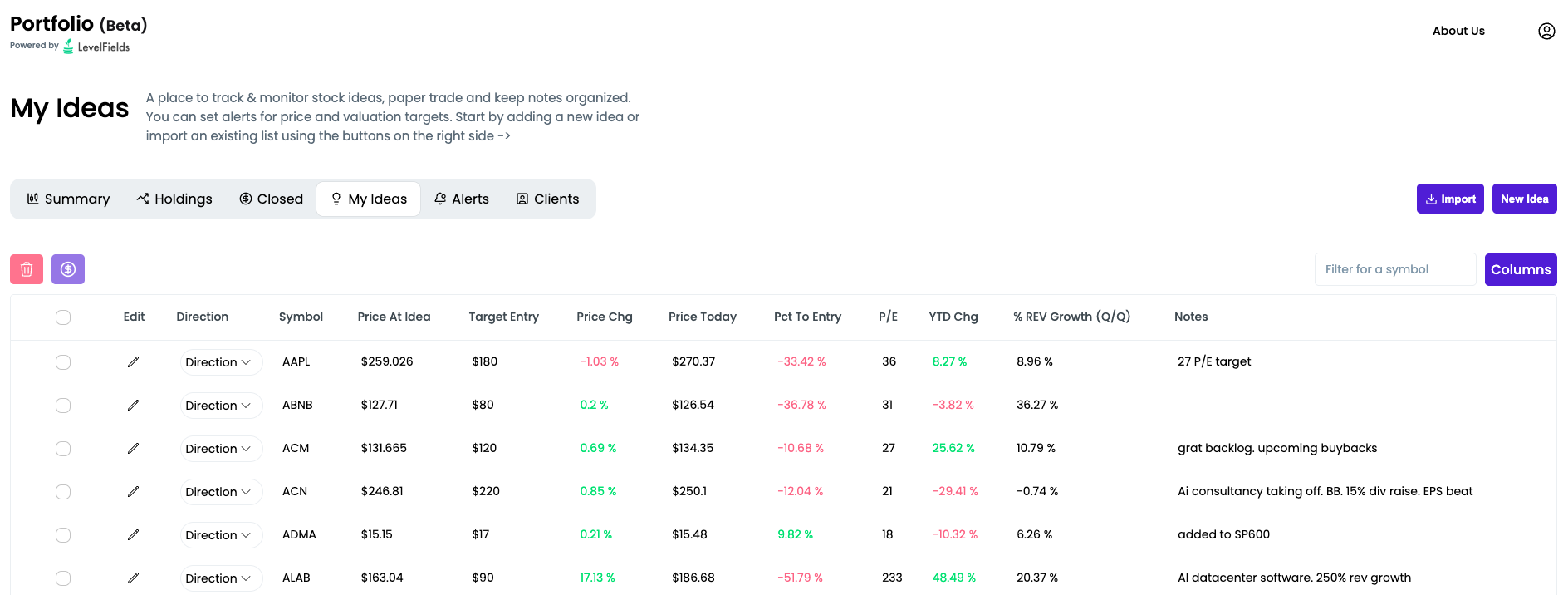
We’ve just launched the new LevelFields Portfolio platform — a centralized dashboard built for active investors and wealth managers to track their trades, organize trade ideas, and monitor real or prospective portfolios.
We've replaced Excel and Google Sheets trade tracking with software that updates as prices and valuations of stocks change, so you don't lose money by missing great entry and exit points.
You can sign up for free!
What it does:
- Lets you add both real positions and idea-stage trades into one unified portfolio.
- Tracks allocation, profit/loss, KPIs, P/E, price targets, and thesis notes in one place.
- Allows you to set real-time alerts on valuation changes, price moves, and price targets using bulk editing (e.g. one alert for all holdings).
- Lets you toggle any ticker between “Idea → Holding → Closed” while preserving the original trade thesis and exit notes.
- Designed for traders, advisors, and fund managers who need a live, organized view of positions + rationale, not just a static spreadsheet of tickers.
- Import CSV file of existing ideas, notes, and portfolio holdings for a quick start
- Keep track of reasons you bought and sold to analyze your performance and for compliance
- Design your own model portfolios based on allocations, sector, and industry



.png)
How to use LevelFields for Options Trading
Tracking Stocks Without Spreadsheets
The Truth About Dividend Stocks
What's LevelFields' Premium Membership Provide?
This is not financial advice. All information represent opinions only for informational purposes. Given the vast number of stocks we cover in these reports, assume staff covering stocks have positions in stocks discussed.
Have feedback or a request for specific data? Drop us a note at support@levelfields.org